|
Wildridge Education Software
Anatomy Coloring Books
Janice VanCleave
Nature Studies
Space
Inventors
Horrible Science

 Math & the Cosmos by
Wildridge
Education Math & the Cosmos by
Wildridge
EducationMath & the Cosmos is an interdisciplinary program in which
students study astronomy and its connections to mathematics,
physics, history and mythology.
It combines a challenging textbook with interactive, multimedia exercises. As
students study each section in the textbook, the multimedia exercises help them
understand and apply the information being learned.
Product Features
Recommended for ages 12-18 (grades 7-12)
The CD-ROM operates on a PC or Macintosh. System requirements: Windows 98 or
higher/Macintosh OS 9.x-10.x
Math & the Cosmos does not run well on Vista. Part of the program
will work, but it will not keep the score, etc. The publisher has not been
recommending the program for Vista. When Vista is well established and has all
the bugs worked out, they will then update the program.
Lab packs/Network/volume prices are available. Email us for more information:
orders@FUN-Books.com FAQs
Also available from Wildridge Education:
Math & Music |
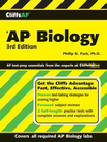
CliffsAP Biology, 3rd ed. by Phillip E. Pack, Ph.D.
This is your complete guide
to a higher score on the AP Biology exam. Included in book: a review of the AP
exam format and scoring, proven strategies for answering multiple-choice
questions, and hints for tackling the essay questions. A list of 14 specific
must-know principles are covered. This title includes sample questions and
answers for each subject. Laboratory Review includes a focused review of all 12
AP laboratory exercises. AP Biology Practice Tests features 2 full-length
practice tests that simulate the actual test along with answers and complete
explanations. AP is a registered trademark of the College Board, which was not
involved in the production of, and does not endorse, this product
Paper, 360
pages.
#7649 $16.99 $11.25


 The
Cartoon Guide to Physics provides a unique approach to a subject usually
considered accessible only to eggheads. It is crammed with clear, concise,
amusing illustrations. Mechanics, electricity and magnetism are the major
subjects covered, subdivided into areas such as motion, projectiles, orbits,
force, energy, charge, electric fields, currents, magnetic fields, relativity,
inductors and quantum electromagnetics. The
Cartoon Guide to Physics provides a unique approach to a subject usually
considered accessible only to eggheads. It is crammed with clear, concise,
amusing illustrations. Mechanics, electricity and magnetism are the major
subjects covered, subdivided into areas such as motion, projectiles, orbits,
force, energy, charge, electric fields, currents, magnetic fields, relativity,
inductors and quantum electromagnetics.Definitions are reduced to clear,
simple sentences, but the book has plenty of equations, which do require some
thought. As palatable as the author makes the subject, it is still physics,
folks! Some of the formulas require time and concentration to absorb. The same
cartoon characters appear throughout the book and provide wry comments.
Thumbnail sketches of physicists dot the book with brief descriptions of their
theories, providing perspective and an idea of how major theories developed and
built over the centuries. A.Y.
#1009 $17.95 $14.99
These Larry Gonick books are also available:
Cartoon Guide to Chemistry #6770 $16.95
$10.99
Sale price!
Cartoon Guide to Genetics #0991X $16.95 $13.55
|
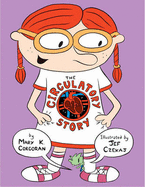 The
Circulatory Story by Mary K. Corcoran, illustrated y Jef Czekaj -
Ready to get pumped? The
Circulatory Story by Mary K. Corcoran, illustrated y Jef Czekaj -
Ready to get pumped?
Simple, humorous text and comic illustrations explain the basics of the
circulatory system - the systemic, pulmonary, and coronary circuits. Readers
follow a red blood cell on the journey through the body and in the process learn
how the body combats disease, performs gas exchanges, and fights plaque.
Colorful illustrations.
Paper, 48 pages. 11"x8.5"x.2"
#2094 $7.95
|
\
 Eyewitness
to Science: Scientists and Writers Illuminate Natural Phenomena from Fossils to
Fractals edited
by John Carey
-Using essays, arguments and investigations by scientists such as Darwin, Huxley
and Fabre, this text plots the development of modern science from Leonardo da
Vinci to the chaos theory. It explores areas as diverse as da Vinci's
observations of nocturnal birds to Asimov's explication of black holes.
Science's most momentous discoveries come alive in 100 brilliant firsthand
accounts. Eyewitness
to Science: Scientists and Writers Illuminate Natural Phenomena from Fossils to
Fractals edited
by John Carey
-Using essays, arguments and investigations by scientists such as Darwin, Huxley
and Fabre, this text plots the development of modern science from Leonardo da
Vinci to the chaos theory. It explores areas as diverse as da Vinci's
observations of nocturnal birds to Asimov's explication of black holes.
Science's most momentous discoveries come alive in 100 brilliant firsthand
accounts.
Includes pieces by Sir Isaac Newton, Erasmus Darwin, Stephen
Jay Gould, Charles Darwin, Sigmund Freud, Orville Wright, Mark Twain, Albert
Einstein, Richard Feynman, Bertrand Russell, Richard Dawkins and many more.
I recommend this book for older teens to adult because of reading level and
also the mature content. Certain sections could be read to younger children.
Paper, 560
pages. 9.3"x6"x1.2".
#755X $16.95
|
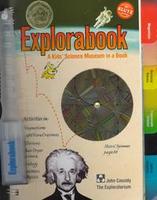 Explorabook There are more than 50 activities contained in this book,
plus the tools to do nearly all of them. Tons of
experiments are featured, and nearly all of them can be done right on the spot,
using the magnifying lens, magnet, agar and other bound-in apparatus. (The
magnet is handy to have around the house long after the book has been used). Explorabook There are more than 50 activities contained in this book,
plus the tools to do nearly all of them. Tons of
experiments are featured, and nearly all of them can be done right on the spot,
using the magnifying lens, magnet, agar and other bound-in apparatus. (The
magnet is handy to have around the house long after the book has been used).
This is a terrific science resource and is like
having a "kids' science museum in a book." Written
by John Cassidy & The Exploratorium.
For ages 8 and up. Coated cardstock, spiral-bound.
#7145 $21.95 $16.99
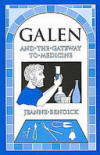 Galen and the Gateway to Medicine
by Jeanne Bendick (author,
Archimedes and the Door to Science) - A physician
born in 129A.D. at the height of the Roman Empire, Galen's perceptive patient
diagnoses, studies of physiology and botanical wisdom were documented in many
books and influenced medicine through the Renaissance. In this interesting
biography, the author "brings Galen's Roman world to life with clarity, humor,
and outstanding content." Galen and the Gateway to Medicine
by Jeanne Bendick (author,
Archimedes and the Door to Science) - A physician
born in 129A.D. at the height of the Roman Empire, Galen's perceptive patient
diagnoses, studies of physiology and botanical wisdom were documented in many
books and influenced medicine through the Renaissance. In this interesting
biography, the author "brings Galen's Roman world to life with clarity, humor,
and outstanding content."
Ages 9-up. Rome, A.D. 129.
Paper, 150 pages.
#7752 $13.99
|
 Galileo's
Daughter by Dava Sobel. Sobel is a talented historian, translator, and
science writer. Her book is a wonderful way to learn about Galileo's life and
about basic physics through his arguments about motion, the tides and the
planets; further, we read later how mathematics came to be applied to science.
Most important, the book brings Galileo's daughter, the nun Suor Maria Celeste,
alive. Her letters about her cloistered life, her feelings and thoughts, and her
relationship with her father, make you feel a genuine depth of faith and love. Galileo's
Daughter by Dava Sobel. Sobel is a talented historian, translator, and
science writer. Her book is a wonderful way to learn about Galileo's life and
about basic physics through his arguments about motion, the tides and the
planets; further, we read later how mathematics came to be applied to science.
Most important, the book brings Galileo's daughter, the nun Suor Maria Celeste,
alive. Her letters about her cloistered life, her feelings and thoughts, and her
relationship with her father, make you feel a genuine depth of faith and love.
In addition, you learn fascinating things about how and why the Church fought
Galileo's ideas about the planets, how people lived during the Plague, the early
history of science, Galileo's invention of the military and geometric compass,
and all sorts of other details that make this much more than a history book.
While the book is beautifully illustrated throughout, it is most appropriate for
experienced readers.
Paper, 420 pages. (We also carry the author's book,
Longitude).
#0553 $15.00 $8.99
Sale!
We have one damaged copy that has a corner crease:
#DAM-0553 $15.00 $6.99
|
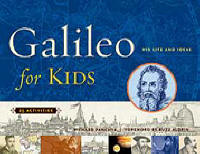 Galileo for Kids: His Life and Ideas by Richard Panchyk, Buzz
Aldrin (Foreword) - Galileo, one of history's best-known scientists, is
introduced in this illuminating activity book. Children will learn how Galileo's
revolutionary discoveries and sometimes controversial theories changed his world
and laid the groundwork for modern astronomy and physics. This book will inspire
kids to be stargazers and future astronauts or scientists as they discover
Galileo's life and work. Galileo for Kids: His Life and Ideas by Richard Panchyk, Buzz
Aldrin (Foreword) - Galileo, one of history's best-known scientists, is
introduced in this illuminating activity book. Children will learn how Galileo's
revolutionary discoveries and sometimes controversial theories changed his world
and laid the groundwork for modern astronomy and physics. This book will inspire
kids to be stargazers and future astronauts or scientists as they discover
Galileo's life and work.
Activities allow children to try some of his theories on their own, with
experiments that include playing with gravity and motion, making a pendulum,
observing the moon, and painting with light and shadow.
Along with the scientific aspects of Galileo's life, his passion for music and
art are discussed and exemplified by period engravings, maps, and prints.
A time line, glossary, and listings of major science museums, planetariums, and
websites for further exploration complement this activity book.
Paper, 184 pages. Ages 9+.
#5667 $16.95 $15.25
|
Five Kids & A Monkey FUNPak
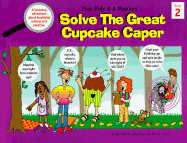
Five Kids & A Monkey Solve the Great Cupcake Caper: A Learning Adventure about
Healthful Eating and Exercise
by Nina Riccio, illustrated by Beth L. Blair. Poor Munchie is having a terrible
day! Things started out just fine, but then he popped a few too many sweets into
his mouth and ended up morphing into a giant cupcake! It's going to take all the
know-how of the Five Kids & A Monkey(tm) detective team to turn Munchie back
into a kid again. Help them decipher codes, uncover clues and unscramble words
while learning how to choose the healthful foods and exercises that will cure
their friend.
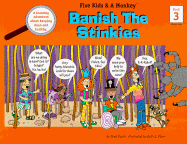
Five Kids & A Monkey Banish the Stinkies: A Learning Adventure about Keeping
Clean and Healthy by Nina Riccio, illustrated by Beth L. Blair - Grub is
the messiest kid on the block. His hair is one big tangle, his clothes are
covered with blotches and stains and his room looks like something exploded in
it! It's going to take some drastic action - like an exploration through Mr.
Picadilly's mouth or an encounter with giant body bugs - to get him to clean up
his act. And Grub will need your help cracking codes, deciphering devious word
scrambles and hunting down the stinkies hidden throughout this book!
Set includes Book 2 and 3 in the Five Kids & A Monkey series.
Paper, 32 pages each. 10.9"x8.5"x.3". Ages 4-8. Some mild edgewear.
#FUN96 $15.90
One copy available.
|
 History of Science Timeline
2-Student Pack compiled by Rea Berg
(Beautiful Feet Books) - This time line goes back to the ancient world of
Pythagoras, Aristotle and Archimedes, to the medieval world of Copernicus and
Galileo, up to the modern world of Edison and Einstein. With a total of
twenty-one illustrations many of the world's most notable scientists will be
brought to life for your student. All the figures are dated with a brief
explanation concerning the discoveries of each individual. Your student will
more fully appreciate the progress of science through the centuries. With their
dated illustrations of significant events and individuals, students cut and
color the detailed drawings and paste them on two card-stock strips which are
able to fold for convenient storage in a notebook. They can also mount their
completed time lines on the wall. History of Science Timeline
2-Student Pack compiled by Rea Berg
(Beautiful Feet Books) - This time line goes back to the ancient world of
Pythagoras, Aristotle and Archimedes, to the medieval world of Copernicus and
Galileo, up to the modern world of Edison and Einstein. With a total of
twenty-one illustrations many of the world's most notable scientists will be
brought to life for your student. All the figures are dated with a brief
explanation concerning the discoveries of each individual. Your student will
more fully appreciate the progress of science through the centuries. With their
dated illustrations of significant events and individuals, students cut and
color the detailed drawings and paste them on two card-stock strips which are
able to fold for convenient storage in a notebook. They can also mount their
completed time lines on the wall.
#BF17B $34.95 $13.95
2-Student Pack
 How to Write & Publish a Scientific Paper, 4th edition by Robert
A. Day - To be useful,
scientific research needs to be explained clearly to others - to colleagues, to
administrators, to foundations and governmental bodies, and to the public.
How to Write and Publish a Scientific Paper gives beginning scientists and
experienced researchers alike practical advice on writing about their work and
publishing what they write. The core of the book consists of a how-to guide to
writing and publishing research articles for scientific journals, explaining
every step of the process, from choosing a suitable journal for your work to
presenting the results and citing references. How to Write & Publish a Scientific Paper, 4th edition by Robert
A. Day - To be useful,
scientific research needs to be explained clearly to others - to colleagues, to
administrators, to foundations and governmental bodies, and to the public.
How to Write and Publish a Scientific Paper gives beginning scientists and
experienced researchers alike practical advice on writing about their work and
publishing what they write. The core of the book consists of a how-to guide to
writing and publishing research articles for scientific journals, explaining
every step of the process, from choosing a suitable journal for your work to
presenting the results and citing references.
"The only book about scholarly communication that his reviewer
has ever wanted to read from cover to cover". -- ARBA
"Day's style is light and witty; ' his examples memorable, funny, and
instructive; and through it all is a canny wisdom". -- Society for Scholarly
Publishing
"An outstanding book, one to be on the shelf of every scientific writer. Not
that it will stay on the shelf much. Countless anecdotes and unexpected touches
of wit and humor will keep the reader from putting the book away..". -- Issues
in Writing
Paper, 233 pages.
#8654 $29.95 $14.99
One copy available.
|
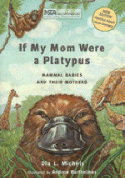 If My Mom Were a Platypus: Animal Babies and Their Mothers by Dia L. Michaels,
illustrated by Andrew Barthelmes. Mother and babies. Babies and mothers. The
animal kingdom offers a special fascination for children because so many of the
cozy rituals they share at home are echoed in nature. In this beguiling approach
to biology, youngsters can learn how animals eat, sleep and learn from birth to
maturity. If My Mom Were a Platypus: Animal Babies and Their Mothers by Dia L. Michaels,
illustrated by Andrew Barthelmes. Mother and babies. Babies and mothers. The
animal kingdom offers a special fascination for children because so many of the
cozy rituals they share at home are echoed in nature. In this beguiling approach
to biology, youngsters can learn how animals eat, sleep and learn from birth to
maturity.
Fourteen different species including the Least Shrew, the Mexican Free-Tailed
Bat and the Hooded Seal are presented in detailed illustrations and a
scrupulously researched text. It ends with the human baby. Breastfeeding moms
(especially those who practice extended nursing) will enjoy the fact that only
breast milk is shown as the baby's first food, and the author - from the
perspective of the human baby - says, "By the time I was a few years old, I lost
interest in nursing...."
The writing is intended for ages 8-12, but younger children would enjoy this
very much as a read-aloud.
Paper, 64 pages. Lots of colorful illustrations. 7"x10".
#5190 $9.95
|
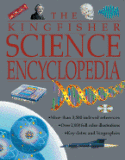 Kingfisher Science Encyclopedia (2000 edition) edited by Charles
Taylor -
An illustrated science encyclopedia
arranged in such categories as "Planet Earth", "Living Things", "Chemistry and
the Elements", "Materials and Technology", "Space and Time", and "Conservation
and the Environment". It covers a variety of subjects with clear text and
detailed illustrations and photographs. Kingfisher Science Encyclopedia (2000 edition) edited by Charles
Taylor -
An illustrated science encyclopedia
arranged in such categories as "Planet Earth", "Living Things", "Chemistry and
the Elements", "Materials and Technology", "Space and Time", and "Conservation
and the Environment". It covers a variety of subjects with clear text and
detailed illustrations and photographs.
More than 3,500 indexed references, over 2,000 full-color illustrations, and key
dates & biographies. Comprehensive index, glossary.
Hardcover, 496 pages. 11.2"x8.9"x1.8" inches
(heavy book). The back cover has some
scratches. Ages 9-12.
#2691 $39.95 $24.99
(Out of print, one copy available).
|
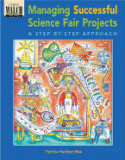 Managing Successful Science Fair Projects: A Step-by-Step Approach
by Patricia Hachten Wee - Here's all the material you need to keep learners
on-task through the whole science project process. Organize your science fair
and save your sanity! Guides your learners through a 14-step process of
selecting, researching, and presenting a science fair project Includes
reproducible checklist, schedules, tip sheets, topic ideas, references,
suppliers, student progress sheet, and more. Managing Successful Science Fair Projects: A Step-by-Step Approach
by Patricia Hachten Wee - Here's all the material you need to keep learners
on-task through the whole science project process. Organize your science fair
and save your sanity! Guides your learners through a 14-step process of
selecting, researching, and presenting a science fair project Includes
reproducible checklist, schedules, tip sheets, topic ideas, references,
suppliers, student progress sheet, and more.
Paper, 81 pages. 10.5"x 8"x0.3".
#8042X $20.99 $18.99
|
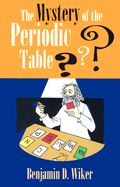 Mystery of the Periodic Table
by Benjamin D Wiker leads the reader on a delightful and absorbing journey
through the ages, on the trail of the elements of the Periodic Table as we know
them today. Introduces the young reader to people like Von Helmont, Boyle,
Stahl, Priestly, Cavendish, Lavoisier, and many others, all incredibly diverse
in personality and approach, who have laid the groundwork for a search that is
still unfolding. Mystery of the Periodic Table
by Benjamin D Wiker leads the reader on a delightful and absorbing journey
through the ages, on the trail of the elements of the Periodic Table as we know
them today. Introduces the young reader to people like Von Helmont, Boyle,
Stahl, Priestly, Cavendish, Lavoisier, and many others, all incredibly diverse
in personality and approach, who have laid the groundwork for a search that is
still unfolding.
The first part of the book is most suitable to 10+, while the later chapters are
designed for ages 12-13 and up, with a final chapter that is somewhat more
advanced. Older readers like me, who never took chemistry, will find the book
very helpful. There's loads of interesting information.
#771X $14.95
|
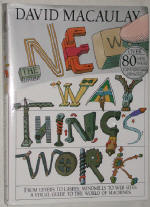 The New Way Things Work
by David Macaulay. With the help of a charming Wooly Mammoth, readers are
introduced to the physical and mechanical world. The book covers the workings of
hundreds of machines and devices: levels, wheels, gears, pulleys, flying,
pressure power, photography, printing, music, electricity, magnetism, sensors,
computers and more. A great reference to have in your family library. This
completely updated and expanded edition describes twelve new machines and
includes more than seventy new pages detailing the latest innovations. The
publisher recommends the book for ages 12+, but this is a great reference to
have around for all ages. The New Way Things Work
by David Macaulay. With the help of a charming Wooly Mammoth, readers are
introduced to the physical and mechanical world. The book covers the workings of
hundreds of machines and devices: levels, wheels, gears, pulleys, flying,
pressure power, photography, printing, music, electricity, magnetism, sensors,
computers and more. A great reference to have in your family library. This
completely updated and expanded edition describes twelve new machines and
includes more than seventy new pages detailing the latest innovations. The
publisher recommends the book for ages 12+, but this is a great reference to
have around for all ages.
Winner of the 1999 Parents’ Choice Gold Award.
Revised
edition, hardcover, 400 pages.
#8473 $35.00
|
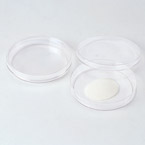 Petri
Dishes with Agar, Set of 2 -
Children can grow their own bacteria specimens with this set. Includes: packet
of agar, two plastic Petri dishes and agar preparation instructions. Petri
Dishes with Agar, Set of 2 -
Children can grow their own bacteria specimens with this set. Includes: packet
of agar, two plastic Petri dishes and agar preparation instructions.
Ages 8-17.
#2583 $7.99
|
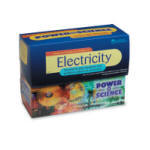 Power of Science Electricity Kit
(Learning Resources) Get students charged up about static and current
electricity, circuits, switches, fuses and electromagnetism. Over 30 science
experiments and projects for your classroom or group, including demonstration
materials. Power of Science Electricity Kit
(Learning Resources) Get students charged up about static and current
electricity, circuits, switches, fuses and electromagnetism. Over 30 science
experiments and projects for your classroom or group, including demonstration
materials.
Includes: materials for teacher demonstrations & classroom
activities, 32-page teacher's guide (teaching tips & instructions, reproducible
blackline masters, cross-curicular extensions), real-world science applications,
24 activity cards, 15 feet of wire, 8 2-volt batteries, 8 brass switch plates,
felt cloth, 1 magnet, 8 sockets, 1 nichrome wire filament, 16 nuts and bolts, 12
balloons, 32 nails, aluminum foil.
Ages 9-11.
#2001 $64.99 $44.99
One kit available.
 Science
Experiment Pamphlets (Published by Beautiful Feet Books) -
This booklet provides instructions for the experiments assigned in Beautiful
Feet's History of Science Study Guide. However, you don't need the
guide to do the experiments. Includes activities like, locating your center of
gravity, density investigations, making a rocket boat, and learning about
evaporation. Science
Experiment Pamphlets (Published by Beautiful Feet Books) -
This booklet provides instructions for the experiments assigned in Beautiful
Feet's History of Science Study Guide. However, you don't need the
guide to do the experiments. Includes activities like, locating your center of
gravity, density investigations, making a rocket boat, and learning about
evaporation.
All experiments use items easily found around the house and
are easily accomplished. Parental oversight recommended when performing
experiments.
Paper, 70 pages. Spiral bound. It's a trim booklet.
#BF07 $6.00 $4.99
One copy available.
|
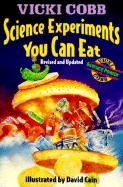
Science Experiments You Can Eat by Vicki Cobb.
Hungry for science? Do your science project and eat it too! The procedures,
materials needed, and observations are listed for each experiment.
Paper, 214
pages.
#0029 $5.99
|
 Science
Fair Projects for Dummies by Maxine Levaren -
Stuck on what to do for your science
project? This easy-to-follow guide is chock-full of more than 50 fun ideas and
experiments in everything from astronomy to zoology. Your ultimate guide to
creating crowd-pleasing displays, it shows you everything you need to know to:
choose the best project idea for you; make sure your project idea is safe,
affordable, and doable; research, take notes, and organize your facts; write a
clear informative research paper; design and execute your projects; ace the
presentation; and wow the judges. Science
Fair Projects for Dummies by Maxine Levaren -
Stuck on what to do for your science
project? This easy-to-follow guide is chock-full of more than 50 fun ideas and
experiments in everything from astronomy to zoology. Your ultimate guide to
creating crowd-pleasing displays, it shows you everything you need to know to:
choose the best project idea for you; make sure your project idea is safe,
affordable, and doable; research, take notes, and organize your facts; write a
clear informative research paper; design and execute your projects; ace the
presentation; and wow the judges.
Paper, 379 pages. 9"x7.4"x0.9".
#4605 $19.99 $13.99
One copy available.
|
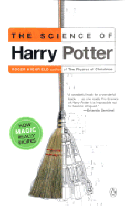 The
Science of Harry Potter
by Roger Highfield - Can Fluffy the three-headed dog be explained by advances in
molecular biology? Could the discovry of cosmic "gravity-shielding effects"
unlock the secret to the Nimbus 2000 broomstick's ability to fly? Is the griffin
really none other than the dinosaur Protoceratops? The author explores the
fascinating links between magic and science to reveal that much of what strikes
us as supremely strange in the Potter books can actually be explained by the
conjurings of the scientific mind. The
Science of Harry Potter
by Roger Highfield - Can Fluffy the three-headed dog be explained by advances in
molecular biology? Could the discovry of cosmic "gravity-shielding effects"
unlock the secret to the Nimbus 2000 broomstick's ability to fly? Is the griffin
really none other than the dinosaur Protoceratops? The author explores the
fascinating links between magic and science to reveal that much of what strikes
us as supremely strange in the Potter books can actually be explained by the
conjurings of the scientific mind.
Parents can use this as a guide to
teach their children science through the adventures of their favorite hero, as
well as for adult fans of the series intrigued by the factual foundations of its
marvels and mysteries.
Paper, 344 pages. 8.2"x5"x.7".
#3557 $14.00 $9.99
One copy available, page edges are starting to yello.
|
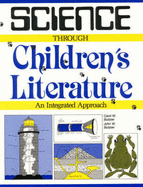 Science
Through Children's Literature; An Integrated Approach (1989 edition) by
Carol & John Butzow -
This
resource features more than 30 children's fiction titles that are rich in
scientific concepts yet equally well-known for their story lines and universal
appeal. Science
Through Children's Literature; An Integrated Approach (1989 edition) by
Carol & John Butzow -
This
resource features more than 30 children's fiction titles that are rich in
scientific concepts yet equally well-known for their story lines and universal
appeal.
Over 30 instructional
units integrate science and literature, providing reading & writing activities
as well as science experiments.
With each chapter there is also a list of related sources. For ages 4-9, but
activities can be used with appropriate titles for older children.
Paper, 260 pages. 11"x8.6"x0.6.
One corner has creasing and there is some discoloration on the bottom of the
book (not on the cover).
#6675 $29.00 $15.00
|
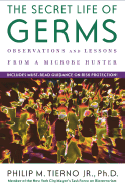
The Secret Life of Germs: Observations and Lessons from a Microbe
Hunter by Philip M. Tierno Jr, Ph.D. -
The
world-renowned doctor who cracked the Toxic Shock riddle now cuts through the
collective germaphobia with a fascinating journey through the vast germ universe
with reassuring guidance on risk protection.
Hardcover, 304 pages. 9.6 x 6.4 x 1.
#1876 $25.00 $17.99
Out of print; one copy available.
|
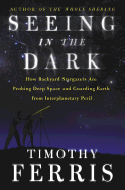
Seeing
in the Dark: How Backyard Stargazers are Probing Deep Space and Guarding Earth
from Interplanetary Peril
by Timothy Ferris. America's finest science writer describes a major revolution
sweeping astronomy, as amateur astronomers, in global networks linked by the
Internet, make discoveries worthy of the professionals that are changing
knowledge of the universe. The appendix includes star charts, observing lists,
and a guide on how to get involved with the stars
Hardcover, 400 pages.
7.3"x5.3"x.3".
#5793 $26.00 $19.99
One copy available.
|
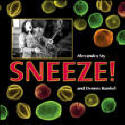 Sneeze!
by Alexandra Siy and Dennis Kunkel - There's something in the air-pollen, dust
mites, mold spores, dust, goose down, cat hair, pepper, flu viruses, and bright
light-that's causing nine different kids to sneeze. Vivid, full color
micrographs show the pesky allergens and irritants that cause the sneeze reflex,
while simple scientific text explains how the impulse to sneeze is created
inside the body. The micrographs magnify the tiny sneeze-inducing irritants, as
well as human nerves and neurons, 400 to 222,220 times larger than life. Sneeze!
by Alexandra Siy and Dennis Kunkel - There's something in the air-pollen, dust
mites, mold spores, dust, goose down, cat hair, pepper, flu viruses, and bright
light-that's causing nine different kids to sneeze. Vivid, full color
micrographs show the pesky allergens and irritants that cause the sneeze reflex,
while simple scientific text explains how the impulse to sneeze is created
inside the body. The micrographs magnify the tiny sneeze-inducing irritants, as
well as human nerves and neurons, 400 to 222,220 times larger than life.
This book provides a fascinating look at an experience common to us all.
Grownups will enjoying the information as well.A glossary and other resources
included.
Paper, 48 pages. Ages 7-10.
#6540 $6.95
|
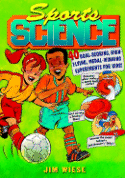 Sports
Science: 40 Goal-Scoring, High-Flying, Medal-Winning Experiments for Kids!
by Jim Wiese - Have you ever wondered if there's a secret to stopping a soccer
ball, why ice skates have metal blades, or how a boat can sail into the wind?
Would you like to learn to balance like a gymnast, how to improve your
free-throw ability, or how to swim like a shark? Are you looking for exciting
ideas foryour next science fair project? Sports
Science: 40 Goal-Scoring, High-Flying, Medal-Winning Experiments for Kids!
by Jim Wiese - Have you ever wondered if there's a secret to stopping a soccer
ball, why ice skates have metal blades, or how a boat can sail into the wind?
Would you like to learn to balance like a gymnast, how to improve your
free-throw ability, or how to swim like a shark? Are you looking for exciting
ideas foryour next science fair project?From basketball to biking to
snowboarding and more, you'll discover the science behind all your favorite
sports. Dozens of fun-filled activities help you see for yourself how a batter
can hit a 90-mile-an-hour pitch, why a "spiral" is the best way to throw a
football, how the surface of a ball affects its bounce and much more. All of the
projects are safe and easy to do, and all you need is everyday stuff from around
the house.
Paper, 128 pages. Ages 9-12. 9.75"x7"x.5".
#2585 $12.95 $7.99
Sale - while supplies last!
|
 Switched-On Schoolhouse Science, Grade 8 (CD-Rom) 2002
by Alpha Omega Publications
-
Switched-On Schoolhouse Science is a Bible-based curriculum. Students focus on
the development of observational skills as they study the physical universe. The
program offers an interactive environment featuring a dynamic mix of text,
multimedia clips, and animation. It includes built-in quizzes and tests. Also
included is automatic lesson planning and record-keeping. Switched-On Schoolhouse Science, Grade 8 (CD-Rom) 2002
by Alpha Omega Publications
-
Switched-On Schoolhouse Science is a Bible-based curriculum. Students focus on
the development of observational skills as they study the physical universe. The
program offers an interactive environment featuring a dynamic mix of text,
multimedia clips, and animation. It includes built-in quizzes and tests. Also
included is automatic lesson planning and record-keeping.
Boxed set includes CD-Rom and Program Guide/Teacher Manual.
While
this set has never been used (CD-Rom is shrink-wrapped), the box is banged up.
Also, this is an older edition of the program.
#9605 $66.95 $39.99
One copy available.
The author's hands-on science books have lots of helpful illustrations
and hundreds of safe, low-cost experiments and activities that make learning the
basics of science fun. Paper. Ages 8-12
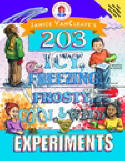 Janice
VanCleave's 203 Icy, Freezing, Frosty, Cool, and Wild Experiments
covers a wide
variety of scientific topics, giving kids loads of ideas for that upcoming
science fair project, or for just plain fun! Whether they want to study the
stars, molecules, plants, or insects, it's all in this one book! Make your own
astrolabe and measure the altitude of the stars, transform dishwashing liquid
into intricate crystal formations, use Gummi Bear candy to study how water is
absorbed and much more. Janice
VanCleave's 203 Icy, Freezing, Frosty, Cool, and Wild Experiments
covers a wide
variety of scientific topics, giving kids loads of ideas for that upcoming
science fair project, or for just plain fun! Whether they want to study the
stars, molecules, plants, or insects, it's all in this one book! Make your own
astrolabe and measure the altitude of the stars, transform dishwashing liquid
into intricate crystal formations, use Gummi Bear candy to study how water is
absorbed and much more.
Simple step-by-step instructions that both
parents and kids can understand.
Paper, 128
pages. Ages 8-12.
#2239 $12.95 $9.99
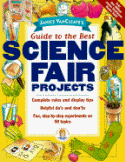 Janice VanCleave's Guide to the Best
Science Fair Projects -
A collection of 50 science projects on
such topics as astronomy, biology, earth science, engineering, physical science,
and mathematics. Also included are tips of how to select a project, how to put
together a professional looking display, and how to present the project to
judges. A collection
of 50 science projects on such topics as astronomy, biology, earth science,
engineering, physical science, and mathematics. Also included are tips of how to
select a project, how to put together a professional looking display, and how to
present the project to judges.
Hide Janice VanCleave's Guide to the Best
Science Fair Projects -
A collection of 50 science projects on
such topics as astronomy, biology, earth science, engineering, physical science,
and mathematics. Also included are tips of how to select a project, how to put
together a professional looking display, and how to present the project to
judges. A collection
of 50 science projects on such topics as astronomy, biology, earth science,
engineering, physical science, and mathematics. Also included are tips of how to
select a project, how to put together a professional looking display, and how to
present the project to judges.
Hide
Paper, 160
pages. 10.9"x8.5"x.25". Ages 9-12.
#8029 $14.95 $9.99
Janice Van Cleave Books:
Astronomy for Every Kid
#5737 $12.95 $9.99
Biology for Every Kid
#3819 $12.95 $9.99
Chemistry for Every Kid
#0858 $12.95 $9.99

Ecology for Every Kid
#0862 $10.95 $ 8.75
Geography for Every Kid - Learn about topographic maps,
latitude and longitude, legends, scales, how to make a compass, and more.
#8429 $12.95 $9.99
|
Human Body for Every Kid
#4082 $12.95 $9.99
Physics for Every Kid
#5057 $12.95 $9.99
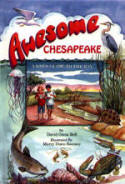 Awesome
Chesapeake: A Kid's Guide to the Bay by David Owen Bell, illustrated by Marcy
Dunn Ramsey - The Chesapeake Bay is certainly an amazing body of water -- the
largest estuary in North America. This book, the first of its kind, stimulates
elementary and middle school children's interest in the Bay by exposing them to
the fascinating creatures and plants found in and around the Bay's 2,500 square
miles. Awesome
Chesapeake: A Kid's Guide to the Bay by David Owen Bell, illustrated by Marcy
Dunn Ramsey - The Chesapeake Bay is certainly an amazing body of water -- the
largest estuary in North America. This book, the first of its kind, stimulates
elementary and middle school children's interest in the Bay by exposing them to
the fascinating creatures and plants found in and around the Bay's 2,500 square
miles.
Concepts like watershed, airshed, and food web as they relate to the Bay are
explained in concise, understandable terms to promote awareness of the human
role -- for good or ill -- in this vast system. This book is an effective means
for children to discover the interesting traits of some of the plants, animals,
birds, and fish they are likely to find in and around the Bay. Outstanding
drawings bring the estuary and its inhabitants to life.
Hardcover, 44 pages. 9.3 x 6.3 x 0.4.
#4573 $11.95
Out of print; one copy available.
|
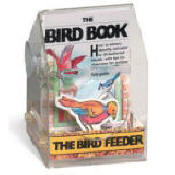 Bird
Feeder - Perfect for any beginning bird watcher, here is an illustrated
field guide to 30 common North American backyard bird species, nestled in its
own plastic bird feeder. Featuring everything from Jays to Juncos to Song
Sparrows to Chickadees, the book also explains how to set up the feeder, what
kinds of food to serve when, and how to keep unwelcome guests away. Plus, learn
all about migration, nesting, and the fun of keeping a bird journal. Bird
Feeder - Perfect for any beginning bird watcher, here is an illustrated
field guide to 30 common North American backyard bird species, nestled in its
own plastic bird feeder. Featuring everything from Jays to Juncos to Song
Sparrows to Chickadees, the book also explains how to set up the feeder, what
kinds of food to serve when, and how to keep unwelcome guests away. Plus, learn
all about migration, nesting, and the fun of keeping a bird journal.
The see-through plastic feeder comes with two suction cups, and can attach to
the window, sit on the sill, or hang from a tree. Use it and learn from it all
year long. Designed for ages 5-12, but the whole family will enjoy it.
#6148 $14.95
|
 Ecology (Thematic Unit) by Mary Ellen Sterling is a thematic unit
about saving our earth. There are 80 reproducible pages filled with a wide
variety of lesson ideas. At its core are activities for three high-quality
children's literature selections (you will need to buy the individual books
separately): The Wump World, One Day in the Tropical Rain Forest, and
50 Simple Things Kids Can Do To Save the Earth. For each of these books
activities are included which set the stage for reading, encourage enjoyment of
the book, and extend the concepts gained. Ecology (Thematic Unit) by Mary Ellen Sterling is a thematic unit
about saving our earth. There are 80 reproducible pages filled with a wide
variety of lesson ideas. At its core are activities for three high-quality
children's literature selections (you will need to buy the individual books
separately): The Wump World, One Day in the Tropical Rain Forest, and
50 Simple Things Kids Can Do To Save the Earth. For each of these books
activities are included which set the stage for reading, encourage enjoyment of
the book, and extend the concepts gained.
Paper, 80 pages. 10.9"x8.6"x0.2". Ages 8-10.
#2865X $9.99 $8.99
(Out of print, one copy available).
|
 Chesapeake
Bay: Nature of the Estuary: A Field Guide by Christopher P. White, with
drawings by Karen Teramura - This book has become the definitive field guide to
the Chesapeake. Flora and fauna descriptions are arranged according to the Bay's
nine major habitats -- from freshwater wetlands to saltwater marshes.
Accordingly, readers can easily refer to the habitat in which they might be
canoeing, for instance, and find the species that are common there. Chesapeake
Bay: Nature of the Estuary: A Field Guide by Christopher P. White, with
drawings by Karen Teramura - This book has become the definitive field guide to
the Chesapeake. Flora and fauna descriptions are arranged according to the Bay's
nine major habitats -- from freshwater wetlands to saltwater marshes.
Accordingly, readers can easily refer to the habitat in which they might be
canoeing, for instance, and find the species that are common there.
As a further aid in this process, the most important field marks of more than
500 species are shown in 350 superb pen-and-ink drawings, which make this
benchmark work as visually appealing as it is useful.
Paper, 224 pages. 9 x 6.1 x 0.5.
#3518 $14.95 $13.99
|
 Insectigations: 40 Hands-on Activities to Explore the Insect World by Cindy Blobaum - From butterflies and beetles to crickets and katydids, these
experiments, art projects, and games will bring out the entomologist in every
kid. Activities include collecting and sketching insects, making a terrarium for
observation, raising mealworms, using math to measure bug strength, gardening to
attract butterflies and other insects, and making an insect amplifier. A unique
insect board game helps kids learn fascinating bug facts while they play. Insectigations: 40 Hands-on Activities to Explore the Insect World by Cindy Blobaum - From butterflies and beetles to crickets and katydids, these
experiments, art projects, and games will bring out the entomologist in every
kid. Activities include collecting and sketching insects, making a terrarium for
observation, raising mealworms, using math to measure bug strength, gardening to
attract butterflies and other insects, and making an insect amplifier. A unique
insect board game helps kids learn fascinating bug facts while they play.
Sidebars offer a look into the world of professional entomology, as well as
gross facts about insects that will provide great playground trivia, including
the USDA's guidelines for allowable insect parts per cup of food. Kids will
learn that science is not just something to read about but something they can
observe and study in the world around them.
Paper, 144 pages. Ages 6-9. 11"x8 1/2"
#5681 $12.95
|
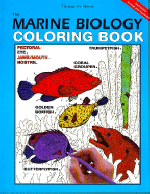 Marine
Biology Coloring Book, second edition by Thomas M. Niesen - Enter the
delicate, complex world of underwater life through extraordinarily detailed,
hand-drawn illustrations and text. The Marine Biology Coloring Book will
serve as an excellent resource and guide. Marine
Biology Coloring Book, second edition by Thomas M. Niesen - Enter the
delicate, complex world of underwater life through extraordinarily detailed,
hand-drawn illustrations and text. The Marine Biology Coloring Book will
serve as an excellent resource and guide.
The process of coloring will focus your attention and leave a visual imprint on
your memory, and details on the natural coloration of the plants and animals
illustrated will help you create an accurate picture of the ocean world. The
text provides a clear introduction to major marine environments as well as an
examination of the lifestyles and interactions of the organisms that inhabit
them.
This edition offers vital information on ocean currents and global weather,
including an explanation of El Nino, the deep-sea realm, and the newest deep-sea
diving research vessels.
Enjoy the process of creating your own beautiful, full-color reference while you
explore a fascinating hidden world. Both the serious student of marine biology
and the weekend beachcomber will gain a better understanding of ocean life by
coloring The Marine Biology Coloring Book.
Paper, 272 pages. 11"x8.25x0.5". For older learners.
#7182 $20.00 $16.99
|
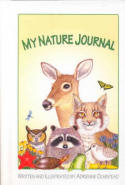
My Nature Journal
written and illustrated by
Adrienne Olmstead is a unique keepsake journal specifically designed to
help children build a lasting personal connection to nature. This book is
interactive, creative and fun. It offers a blend of exploration, discovery and
reflective activities that help kids understand and appreciate nature. Children
can record and draw their discoveries on many pages throughout the journal and
have the opportunity to write their thoughts and feelings about nature along the
way. They will also learn how nature works by being introduced to basic
ecological concepts as they do the journal activities.
My Nature
Journal guides children through five natural worlds: woodlands, meadows,
ponds & streams, and twilight.
Hardcover, with hidden spiral-binding. Color
illustrations throughout. 176 pages. 5.5"x8.5". Ages 8+.
#5911 $17.95
 Oceans:
Sea Life, Exploration, World, Geography (Unit Study Adventures)
by
Amanda Bennett -
While the ocean appears very relaxing topside, a
world teeming with life is hidden just below the surface. From the sight of a
breaching whale and the joyful rolling of a dolphin in the waves to the sounds
of the creaking of a wooden ship under sail, this unit provides loads of fun for
family study. While
the ocean appears very relaxing topside, a world teeming with life is hidden
just below the surface. From the sight of a breaching whale and the joyful
rolling of a dolphin in the waves to the sounds of the creaking of a wooden ship
under sail, this unit provides loads of fun for family study.
Hide Oceans:
Sea Life, Exploration, World, Geography (Unit Study Adventures)
by
Amanda Bennett -
While the ocean appears very relaxing topside, a
world teeming with life is hidden just below the surface. From the sight of a
breaching whale and the joyful rolling of a dolphin in the waves to the sounds
of the creaking of a wooden ship under sail, this unit provides loads of fun for
family study. While
the ocean appears very relaxing topside, a world teeming with life is hidden
just below the surface. From the sight of a breaching whale and the joyful
rolling of a dolphin in the waves to the sounds of the creaking of a wooden ship
under sail, this unit provides loads of fun for family study.
Hide
This unit study will help you "see" the ocean and get a eel for
its amazing beauty. It will also help you understand the important role the
ocean plays in each of our lives. From the impact of the ocean on the weather to
the intricacies of the food chain, this study of the ocean will provide a
lasting awareness of the delicate balance between all the elements of creation.
This guide provides a basic framework for study, along with ideas and
resources. Components include: reading and reference lists, spelling and
vocabulary lists, suggesting resources, activities and field trip lists, and
internet resources list. The left-hand pages of the book have been left
almost-blank for notes, resources, ideas, artwork, or diagrams.
This book
was published in 1996, so some resources may be outdated. Includes some
Christian references.
Paper, 184
pages.
#6088 $16.95 $14.99
Out of print, one copy available.
 Owl Puke: Book and Owl Pellet
by Jane Hammerslough - What is an owl pellet? It's the football-shaped object
regurgitated twice a day by owls, which contains the skeleton of at least one
owl meal, be it a mouse, vole, shrew, or small bird. Owl Puke: Book and Owl Pellet
by Jane Hammerslough - What is an owl pellet? It's the football-shaped object
regurgitated twice a day by owls, which contains the skeleton of at least one
owl meal, be it a mouse, vole, shrew, or small bird.
The Owl Puke kit contains a professionally collected, heat-sterilized owl pellet
and an interesting, two-color illustrated book filled with facts and related
activities about owls. The book covers the food chain, animal anatomy, life in
the forest and much more. It is packed with photographs and illustrations,
charts, stats, and little-known facts. The package includes a tray with 8
dividers to hold the bones and a chart to help identify the pellet's contents.
Each pellet is guaranteed to contain at least one skeleton.
92-page book (4.75"x7"x.25) and kit. Overall product dimensions: 6.75"x7"x1.5"
#1861 $13.95
|
 Pagoo by Holling Clancy Holling. Learn about tide pool life through the
story of Pagoo, a hermit crab. As with other Holling books, intricate margin notes add
detail to the story. Pagoo by Holling Clancy Holling. Learn about tide pool life through the
story of Pagoo, a hermit crab. As with other Holling books, intricate margin notes add
detail to the story.
The book is full of color illustrations. See other Holling books under
Geography.
Paper, 87 pages.
#9641 $11.95
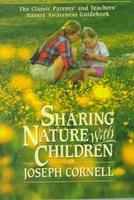 Sharing Nature With Children by Joseph Cornell. A delightful nature awareness
book with helpful ideas and activities to help children become more aware of the earth
around them. One activity involves wearing a blindfold, finding a tree, getting spun and
walked around, and then removing the blindfold and trying to find the tree again. Our
family did this at a local park, and our children were delighted to be able to find
"their" tree and giggled at mom's difficulty in finding the way back to
hers. Sharing Nature With Children by Joseph Cornell. A delightful nature awareness
book with helpful ideas and activities to help children become more aware of the earth
around them. One activity involves wearing a blindfold, finding a tree, getting spun and
walked around, and then removing the blindfold and trying to find the tree again. Our
family did this at a local park, and our children were delighted to be able to find
"their" tree and giggled at mom's difficulty in finding the way back to
hers.
Includes both individual and group activities. Paper, 175 pages. 20th
Anniversary edition, revised & expanded.
#0734 $9.95 $5.99
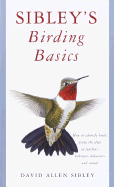 Sibley's
Birding Basics by David Allen Sibley-
One of the foremost painters of American birds, David Allen Sibley, provides
everything birders need to identify birds--by shape, size, color, and
habits--and illustrates it with his incomparable paintings. Sibley's
Birding Basics by David Allen Sibley-
One of the foremost painters of American birds, David Allen Sibley, provides
everything birders need to identify birds--by shape, size, color, and
habits--and illustrates it with his incomparable paintings.
Hits the
mark in terms of content, organization, and readability, Sibley's artwork is
more than impressive; it's incredible! - Birder's World
Paper, 168 pages. 8.2"x5"x.5".
#9665 $15.95 $10.50
One copy available.
|
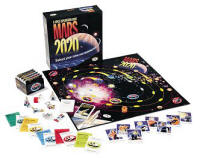 Mars
2020: A Space Exploration Game - This latest game from Aristoplay has become a
favorite in our household. The fact that the playing pieces are six different spaceships
puts it in the "cool game" category right off the bat. The goal is to reach Mars
by the year 2020. Along the way, players experience the science and logic of
space travel, encountering challenges and malfunctions that can be handled by
answering questions about space travel. Mars
2020: A Space Exploration Game - This latest game from Aristoplay has become a
favorite in our household. The fact that the playing pieces are six different spaceships
puts it in the "cool game" category right off the bat. The goal is to reach Mars
by the year 2020. Along the way, players experience the science and logic of
space travel, encountering challenges and malfunctions that can be handled by
answering questions about space travel.
Includes: game board, 6 spaceship
playing pieces, 2 jumbo dice, 1 red-colored marble representing Mars, 8 crew
member cards, 47 mission control cards, 275 spaceport repair cards containing
550 question, and a rule booklet.
2-6 players. Ages 8+.
#627AX $30.00 $27.99
 The Ben Franklin Book of Easy and Incredible Experiments: Activities, Projects, and
Science Fun A Franklin Institute Science Museum Book that focuses on subjects that
were of particular interest to Ben Franklin. It contains activities that are simple to
perform and require only easy-to-find materials, including building a weather station with
homemade barometers and creating an orchestra with panpipes, water chimes and a shoe box
guitar. The Ben Franklin Book of Easy and Incredible Experiments: Activities, Projects, and
Science Fun A Franklin Institute Science Museum Book that focuses on subjects that
were of particular interest to Ben Franklin. It contains activities that are simple to
perform and require only easy-to-find materials, including building a weather station with
homemade barometers and creating an orchestra with panpipes, water chimes and a shoe box
guitar.
Paper, 144 pages. Ages 8-12.
#6384 $12.95 $7.99
Sale - while supplies last!
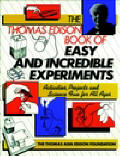
Thomas Edison Book of Easy and Incredible Experiments by The Thomas Alva Edison
Foundation - a collection of fun science activities and projects, covering topics such as
electricity, magnetism, energy, physics and more. Supplies for the experiments
are low-cost items that can easily be found.
Paper, 160 pages.
#0904 $14.95 $13.99
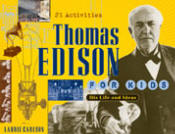 Thomas Edison for Kids: His Life and Ideas, 21 Activities by
Laurie Carlson - Thomas Edison, one of the world's greatest inventors, is
introduced in this fascinating activity book. Children will learn how Edison
ushered in an astounding age of invention with his unique way of looking at
things and refusal to be satisfied with only one solution to a problem. This
book helps inspire kids to be inventors and scientists, as well as persevere
with their own ideas. Thomas Edison for Kids: His Life and Ideas, 21 Activities by
Laurie Carlson - Thomas Edison, one of the world's greatest inventors, is
introduced in this fascinating activity book. Children will learn how Edison
ushered in an astounding age of invention with his unique way of looking at
things and refusal to be satisfied with only one solution to a problem. This
book helps inspire kids to be inventors and scientists, as well as persevere
with their own ideas.
Activities allow children to try Edison's experiments themselves, with
activities such as making a puppet dance using static electricity, manufacturing
a switch for electric current, constructing a telegraph machine, manipulating
sound waves, building an electrical circuit to test for conductors and
insulators, making a zoetrope, and testing a dandelion for latex.
In addition to his inventions and experiments, the book explores Edison's life
outside of science, including his relationship with inventor Nikola Tesla, his
rivalry with George Westinghouse, and his friendship with Henry Ford. A time
line, glossary, and lists of supply sources, places to visit, and websites for
further exploration complement this activity book.
#5841 $14.95 $13.99
|
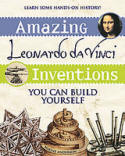 Amazing Leonardo da Vinci Inventions
You Can Build Yourself by Maxine Anderson. From armored tanks and
gliders to "plastic glass" and drawing machines, this interactive book explores
the incredible mind of Leonardo da Vinci through hands-on building projects and
activities. Amazing Leonardo da Vinci Inventions
You Can Build Yourself by Maxine Anderson. From armored tanks and
gliders to "plastic glass" and drawing machines, this interactive book explores
the incredible mind of Leonardo da Vinci through hands-on building projects and
activities.
Most of Leonardo's inventions were never made in his lifetime and remained
sketches in his famous notebooks; kids examine some of these original sketches
and learn about the models he made of his inventions. From there they delve into
detailed step-by-step instructions, diagrams, and templates for each project,
which are interspersed with historical facts, biographical anecdotes, and
trivia. Most of the building can be done using simple household supplies:
construction paper, tape, markers, glue, cardboard tubes, aluminum foil, and
cardboard boxes. Background about the Renaissance as a period of remarkable
achievement in art and science appears throughout the book. There are 25
hands-on building projects and activities.Ages 9 and older.
"Creative, curiosity-provoking, informational, and just plain
fun - kids will find it irresistible" - Rebecca Rupp,
Home Education Magazine
#4426 $14.95 $13.99
|
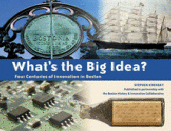 What's
the Big Idea?: Four Centuries of Innovation in Boston by
Stephne Krensky, published in partnership with the Boston History & Innovation
Collaborative -
Since the beginning of the city in 1630, Boston has
been a hub of new ideas that have led America and the world in new directions.
The "City upon a Hill" that John Winthrop dreamed of has been the home of
innovations that range from the use of a vaccine to stop the spread of smallpox
to the invention of the telephone. Even Toll House cookies and personal
computers got their start in Boston. What's
the Big Idea?: Four Centuries of Innovation in Boston by
Stephne Krensky, published in partnership with the Boston History & Innovation
Collaborative -
Since the beginning of the city in 1630, Boston has
been a hub of new ideas that have led America and the world in new directions.
The "City upon a Hill" that John Winthrop dreamed of has been the home of
innovations that range from the use of a vaccine to stop the spread of smallpox
to the invention of the telephone. Even Toll House cookies and personal
computers got their start in Boston.
Photos, painting, and engravings -
and lots of cool facts - bring to life the people, places, and events in Boston
that have changed the course of history.
Paper, 64 pages. 10"x8.75"x.3".
#3114X $9.95 $7.99
One copy available.
|
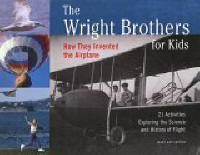 The Wright Brothers for Kids: How They
Invented the Airplane with 21 Activities Exploring the Science and History of
Flight by Mary Kay Carson - Activities exploring the science of history
and flight are scattered throughout a text that provides biographical
information about the two brothers who invented the first powered,
heavier-than-air flying machine. The Wright Brothers for Kids: How They
Invented the Airplane with 21 Activities Exploring the Science and History of
Flight by Mary Kay Carson - Activities exploring the science of history
and flight are scattered throughout a text that provides biographical
information about the two brothers who invented the first powered,
heavier-than-air flying machine.
Design paper gliders, make scones like Wilbur did at camp, build a
rubber-band-powered flyer; create a battery-powered telegraph to send a
telegram; and try other flight-oriented activities.
The book also shows how the brothers overcame obstacles to master the four
forces of flight: lift, thrust, drag, and gravity. And it doesn't forget to
present information about other pioneers of aviation. Included is a time line, a
glossary of terms, and resources (web sites, places to visit, and books to
read). There are illustration, diagrams and lots of photographs, including ones
recently released from the Wright brothers' personal collection.
Ages 9-12. Paper, 146 pages.
#4773 $14.95 $11.25
|
More
Science Pages
Horrible Science
top of page |






































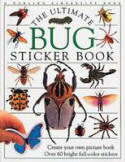 Ultimate Sticker Books (Dorling Kindersley)